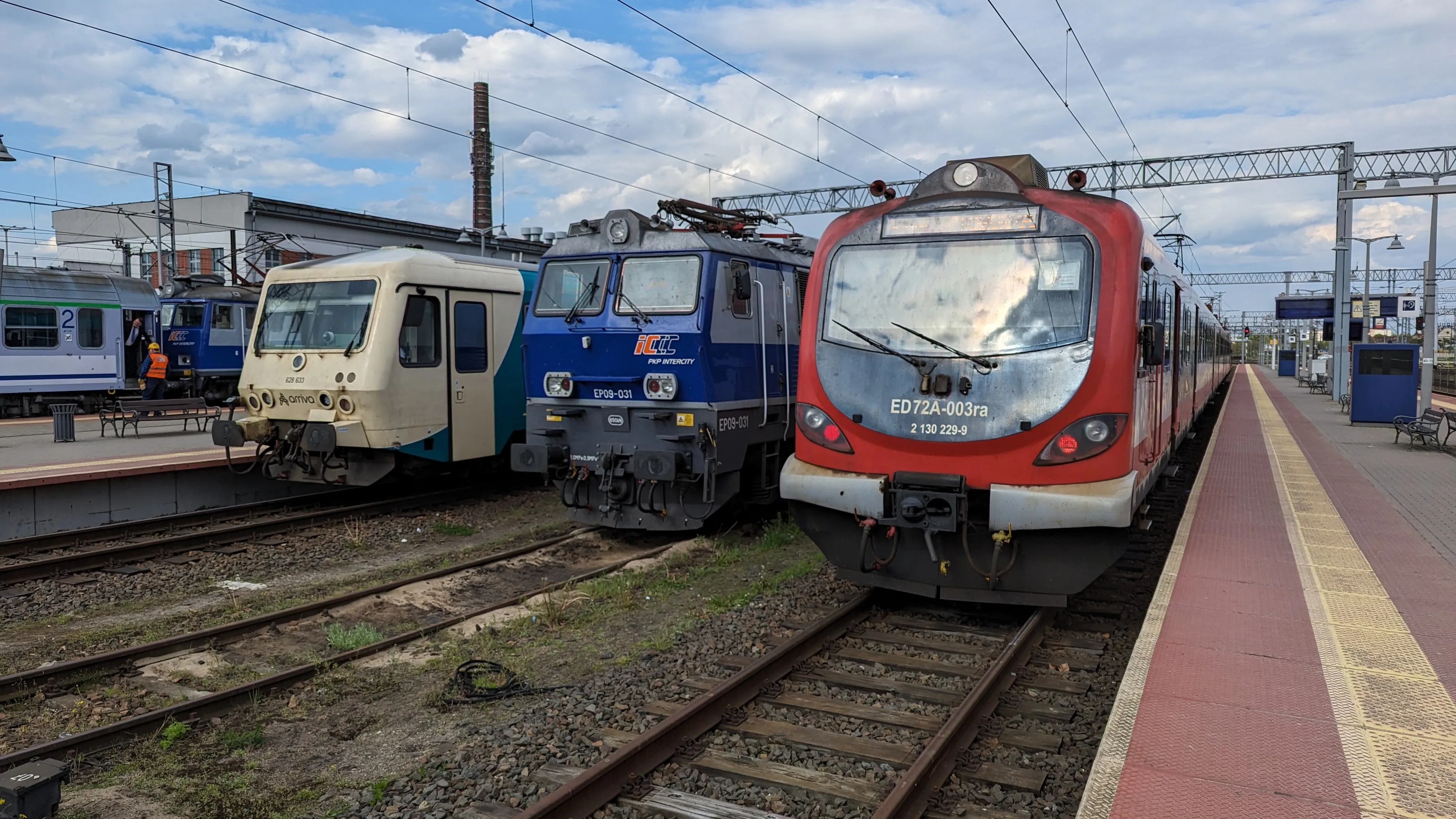
Poland
FIP Information
Poland is the country with the most different railway companies that offer FIP. It depends very much on which voivodeships (parts of Poland) the journeys should go through. The most important operator is the state railway company PKP (Polskie Koleje Państwowe), which with its subsidiaries covers almost the complete long-distance traffic as well as large parts of regional traffic. In addition to PKP Intercity and Polregio, PKP also includes the local rail system of Gdansk (Tri-City) and the regional traffic of Koleje Mazowieckie (KM).
The following regionally operating railway companies offer FIP separately:
- Koleje Dolnośląskie (KD)
- Koleje Małopolskie (KMŁ)
- Koleje Śląskie (KŚ)
- Koleje Wielkopolskie (KW)
- Łódzka Kolej Aglomeracyjna (ŁKA)
The local rail system in Warsaw (Szybka Kolej Miejska w Warszawie) cannot be used with FIP Tickets. It is abbreviated as SKM, just like the one in Gdansk. The Stowarzyszenie Kolejowych Przewozów Lokalnych (SKPL) cannot be used with FIP, unless it operates on behalf of railway companies that accept FIP.
Apart from this, FIP coverage in Poland is very high. In long-distance traffic, reservations are sometimes necessary at PKP InterCity and also generally recommended, as the trains are often very well utilized. In regional traffic, generally only 2nd class is offered.
PKP Portal Pasażera
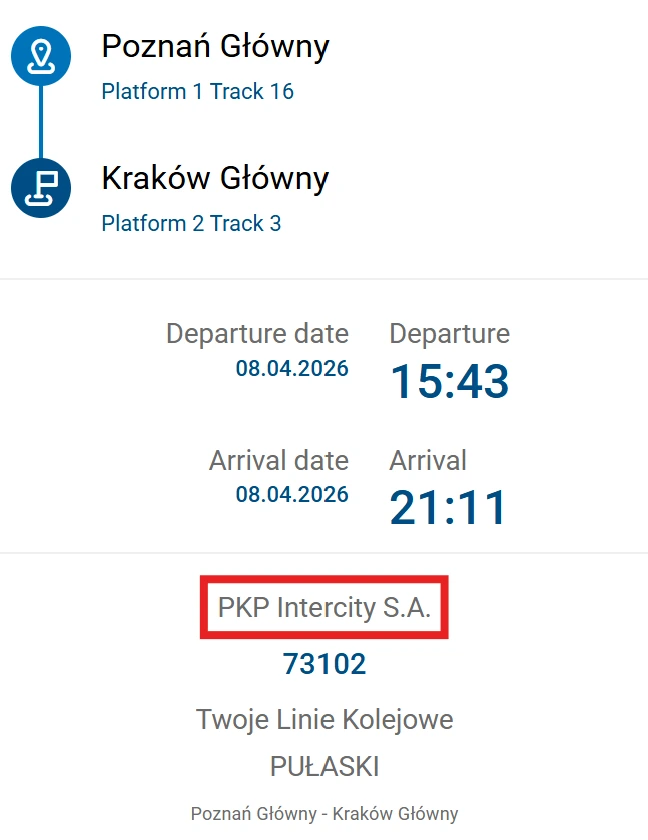
You can search for journeys and trains using the connection search. For each train in a connection, the operator is indicated. For connections with transfers, you need to expand the full connection. The operator (Carrier) is also shown in the connection details.
DB Website
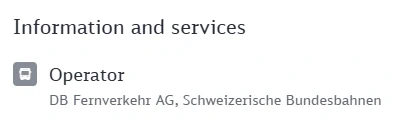
You can search for trains using the journey planner. In the More Information section for each train, the operator is specified. For cross-border connections, multiple operators are often involved.
(The operator information is correct in almost all cases. Outside Germany, operator details may be incorrect if train numbers are used more than once.)
vagonWeb
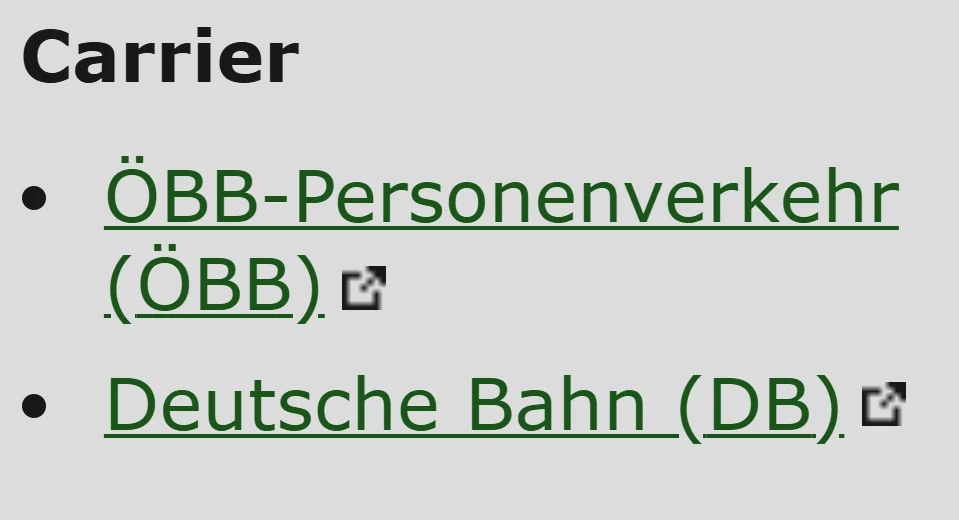
On the vagonWeb website, you can search for individual train numbers. However, it is not possible to search for connections. If several trains with the same train number exist, you must select the correct route of the train. Afterwards, the Carrier is displayed. For cross-border connections, multiple operators are shown.
Interesting
The country has one of the larger rail networks in Europe with about 19,000 km. Especially the main routes between the most important cities have been expanded in recent years for more capacity and higher speeds. The top performer is the Gdansk - Warsaw - Katowice axis with up to 200 km/h. In contrast, there are some routes (especially in regional traffic) that can only be traveled at 60 km/h. In the future, however, high-speed lines with higher speeds across Poland are also planned.
The condition, density and frequency of railway lines are often very dependent on the region. In Lower Silesia (Dolnośląskie), for example, some routes have been reactivated and made more efficient in recent years. In general, however, it can be said that the frequencies are usually in need of improvement. On many routes, only individual trains per day are offered.
Arrival and Border Points
Operators supporting FIP in Poland


Operators without FIP in Poland
- Arriva
- Leo Express
- RegioJet
- Szybka Kolej Miejska w Warszawie
- Stowarzyszenie Kolejowych Przewozów Lokalnych (SKPL)
- Warszawska Kolej Dojazdowa (WKD)